Why frozen treats matter for older dogs
A frozen treat does three quiet things at once for a senior dog. It cools an animal whose body temperature regulation has slipped a step. It keeps water moving through an animal who often won't drink enough on his own. And it gives a dog with stiff joints and slower mornings something small to look forward to.
If you add pet CBD, you're adding one more potential layer — relaxation for an anxious evening, or support for arthritic days. The rest of this guide is about how to do that without accidentally poisoning your dog with an "all-natural" ingredient that looks fine on the label.
Pet CBD — the part most articles get wrong
If you're going to add CBD to a dog treat, here is what actually matters:
- Use a CBD product made for pets. Human CBD tinctures often use carrier oils with xylitol or with concentrations dogs cannot safely process. Pet products are dosed and formulated differently — the dose-per-drop on a human tincture can easily land your dog far over what their endocannabinoid system was designed to handle.
- Look for NASC certification. The National Animal Supplement Council maintains a quality seal program. Brands carrying the NASC Quality Seal have agreed to third-party audits. It's not perfect, but it's the cleanest signal in a still-unregulated category. The FDA has not yet approved any over-the-counter CBD product for animals.
- Start at the manufacturer's lowest recommended dose. Veterinary studies generally cluster around 0.1–0.5 mg/kg twice daily for general wellness, with higher doses (up to ~2 mg/kg) used in clinical osteoarthritis research. (Cornell osteoarthritis study, 2018, often cited as the modern baseline.) Start low — for an arthritic golden retriever that's a few milligrams, not a few hundred.
- Tell your vet, especially if your dog is on other meds. CBD inhibits the same liver enzymes (CYP450 family) that metabolize many veterinary drugs — seizure meds, NSAIDs, blood thinners. The interaction is real and dose-dependent.
- THC is a different story. THC is meaningfully toxic to dogs at modest doses. The phrase "vet-approved pet CBD" in the recipes below explicitly excludes THC. Don't substitute your edible stash for the pet tincture.
Dog-safe terpene sources (and the ones that will hurt)
This is the part of the conversation almost nobody has correctly. "Terpenes" in dog content gets used as a general wellness word, and then someone drops three drops of lavender essential oil into a treat and ends up at the emergency vet. Concentration is the entire problem.
Trace dietary terpenes that are generally fine
- Beta-caryophyllene (β-caryophyllene) — Found in cinnamon, cloves, black pepper, oregano, basil, hops, and rosemary. Of all the terpenes, this one is the most relevant to canine endocannabinoid biology because it actually binds CB2 receptors. A tiny pinch of cinnamon in a treat (Recipe #1) gives you a real-but-modest dose. Cinnamon in small culinary amounts is on the ASPCA's "non-toxic to dogs" list, though large amounts can cause mouth irritation.
- Myrcene — Trace amounts present in mango (small pieces of ripe mango are fine for most dogs). Found heavily in hops — hops are toxic to dogs, so the food source matters.
- Pinene — Present in trace amounts in fresh rosemary leaves. Rosemary is generally regarded as safe for dogs in culinary quantities, though dogs with seizure disorders should avoid it.
What "trace dietary" means
A pinch of cinnamon on a dog treat is not a "terpene dose." It's a flavor and aroma cue, with a small physiological payoff from a tiny amount of β-caryophyllene. That's the whole bargain. If you find yourself measuring terpenes in milligrams, you've already overshot.
What is actively dangerous
- Essential oils of any kind — lavender, eucalyptus, tea tree, peppermint, pine, citrus, wintergreen. The ASPCA Animal Poison Control Center maintains a list of essential oils toxic to dogs and the answer is most of them. Concentration is the problem. A teaspoon of fresh basil chopped into a recipe is fine. A drop of basil essential oil is a several-hundred-fold concentration spike.
- Terpene isolates — same problem in purer form. Isolated linalool or limonene in a few drops can cause central nervous system depression in dogs.
- Hops, in any form — beer-brewing leftover hops have killed dogs through malignant hyperthermia. The fact that hops contain interesting terpenes is irrelevant; the plant itself is the danger.
The recipes below stick to dietary trace amounts in real foods: cinnamon, hemp seed oil, fresh berries. That is the safe lane.
The five recipes
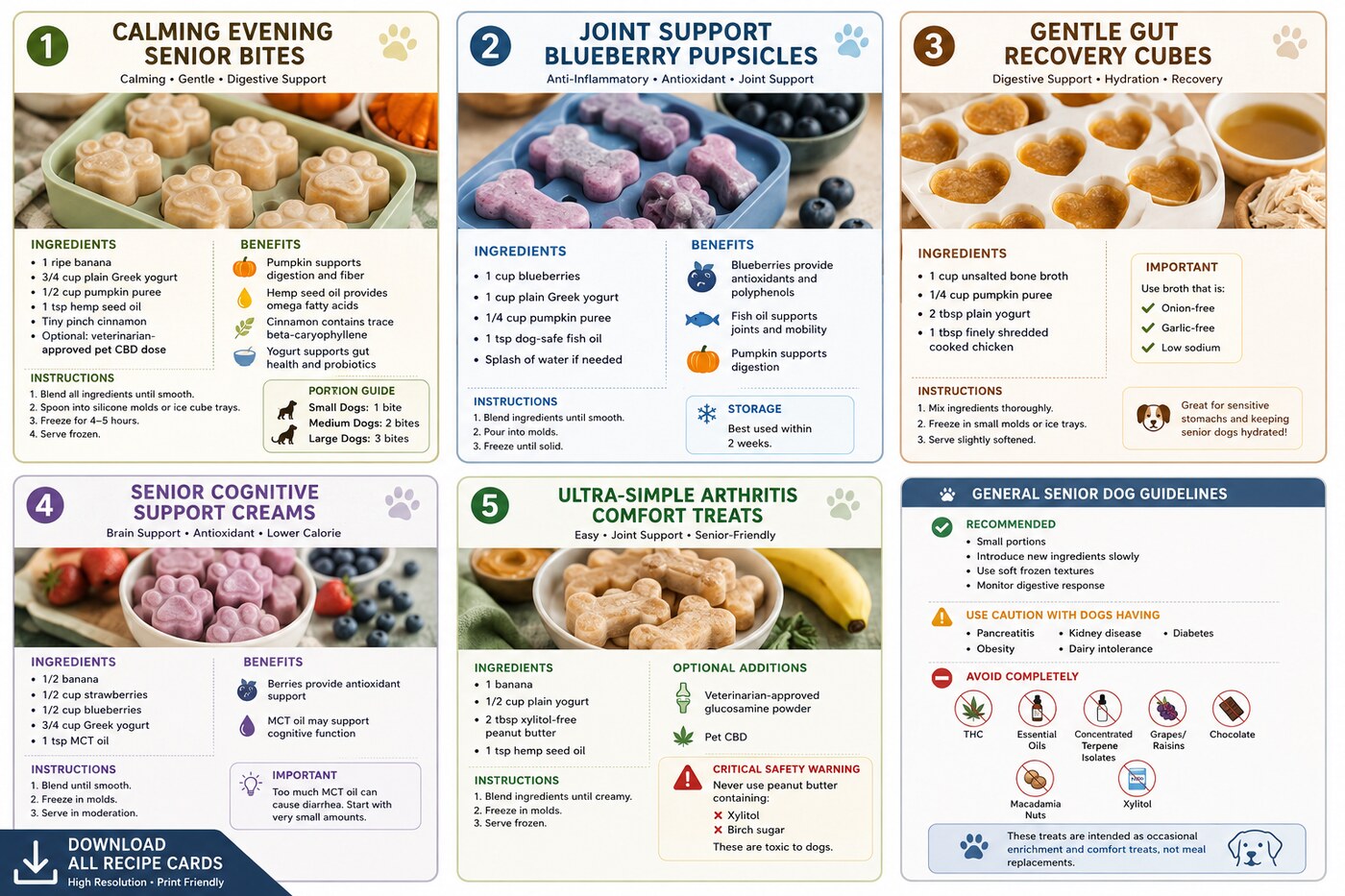
The cards in the hero image at the top are reproduced in full below — and there's a printable cheat sheet at the bottom.
1. Calming Evening Senior Bites
Best for nighttime restlessness, mild anxiety, older dogs needing softer treats.
Ingredients
- 1 ripe banana
- 3/4 cup plain Greek yogurt
- 1/2 cup pumpkin puree
- 1 tsp hemp seed oil
- Tiny pinch cinnamon
- Optional: veterinarian-approved pet CBD dose
Why this works: pumpkin supports digestion and fiber intake; hemp seed oil provides omega-3 and omega-6 fatty acids (no THC, no CBD on its own — hemp seed oil is pressed from the seeds and doesn't carry cannabinoids); cinnamon's trace β-caryophyllene gives a small CB2 nudge; yogurt provides probiotics.
Method. Blend smooth. Spoon into silicone molds or an ice cube tray. Freeze 4–5 hours. Serve frozen.
Portion. Small dog: 1 bite. Medium: 2 bites. Large: 3 bites.
2. Joint Support Blueberry Pupsicles
Best for aging joints, inflammation, antioxidant intake.
Ingredients
- 1 cup blueberries
- 1 cup plain Greek yogurt
- 1/4 cup pumpkin puree
- 1 tsp dog-safe fish oil
- Splash of water if needed
Why this works: blueberry polyphenols are well-studied antioxidants; fish oil's EPA and DHA support joint mobility; pumpkin keeps the stool predictable in dogs on a richer treat.
Method. Blend smooth. Pour into molds. Freeze until solid.
Storage. Best within two weeks.
3. Gentle Gut Recovery Cubes
Best for sensitive stomachs, hydration, recovery after stress or illness.
Ingredients
- 1 cup unsalted bone broth
- 1/4 cup pumpkin puree
- 2 tbsp plain yogurt
- 1 tbsp finely shredded cooked chicken
Read the broth label. Most store-bought "bone broth" contains onion. Onion is toxic to dogs (red blood cell damage). The cleanest move is to simmer bones in water with a carrot and a celery stalk yourself — boring but safe.
Method. Mix thoroughly. Freeze in small molds. Serve slightly softened.
4. Senior Cognitive Support Creams
Best for cognitive aging, brain support, lower-calorie antioxidant treats.
Ingredients
- 1/2 banana
- 1/2 cup strawberries
- 1/2 cup blueberries
- 3/4 cup Greek yogurt
- 1 tsp MCT oil
Why this works: berry polyphenols; MCT oil has some research support for canine cognitive function in older dogs.
Caveat: too much MCT oil causes loose stool. Start with very small amounts the first week.
Method. Blend. Freeze. Serve in moderation.
5. Ultra-Simple Arthritis Comfort Treats
Best for picky senior dogs and easy daily prep.
Ingredients
- 1 banana
- 1/2 cup plain yogurt
- 2 tbsp xylitol-free peanut butter
- 1 tsp hemp seed oil
Optional additions, with vet approval:
- Veterinarian-approved glucosamine powder
- Pet CBD
⚠ Critical safety check on peanut butter. Never use peanut butter that contains xylitol or birch sugar. Both can cause acute liver failure in dogs. Some major brands have started using xylitol without changing the packaging. Check the ingredient list every single time you buy a new jar — not just the first time.
Method. Blend creamy. Freeze. Serve frozen.
General senior dog guidelines
Recommended: small portions, introduce new ingredients slowly, soft frozen textures for older teeth, watch the digestive response over 48 hours after the first try.
Use caution if your dog has pancreatitis, kidney disease, diabetes, obesity, or dairy intolerance (substitute yogurt with goat milk kefir or just more pumpkin).
Avoid completely:
- THC — toxic to dogs even in small amounts
- Essential oils of any kind
- Concentrated terpene isolates
- Grapes / raisins — kidney failure
- Chocolate — theobromine toxicity
- Macadamia nuts
- Xylitol / birch sugar — acute liver failure
- Onions and garlic — red blood cell damage
These treats are occasional enrichment and comfort. They are not meal replacements, and they are not a substitute for veterinary care.
Downloads
Print the cheat sheet, stick it on the fridge, rotate through the five recipes:
A note on what this guide is not
It is not a veterinary prescription. If your dog has a chronic condition — kidney disease, pancreatitis, diabetes, seizures, advanced arthritis — talk to your vet before adding CBD or any new daily supplement. If your dog is on prescription medication, definitely talk to your vet. The drug-interaction surface for CBD in animals is real, and the right move is to have your vet review it once rather than guess.
If your vet is hesitant on CBD specifically, ask them to look at the American Veterinary Medical Association's cannabis resource page — the profession has been moving toward cautious openness on this topic over the last several years.
Good frozen treats are about three things, and CBD is the third: cool body temperature, steady hydration, and an honest moment of comfort. If you do nothing else, do the first two. If you add the third with proper vet guidance, an old dog gets one more good summer afternoon.